 Share
Share




Key benefits
Balanced Lashing System helps maximise deck payload and safety by ensuring lashing forces are shared evenly across the system.
- Up to 10% higher payload capacity allows increased approved stack weights without added structural risk.
- Improved load balance reduces peak stresses, enhancing operational safety by lowering the likelihood of lashing bar failures and container damage.
- Impact force absorption smooths vertical shocks caused by vessel rolling in heavy seas.
- No complex modifications are needed for new builds or ships currently in operation.
Together, these allow you to operate closer to your vessel’s actual capacity while maintaining confidence in safety margins.
Key features
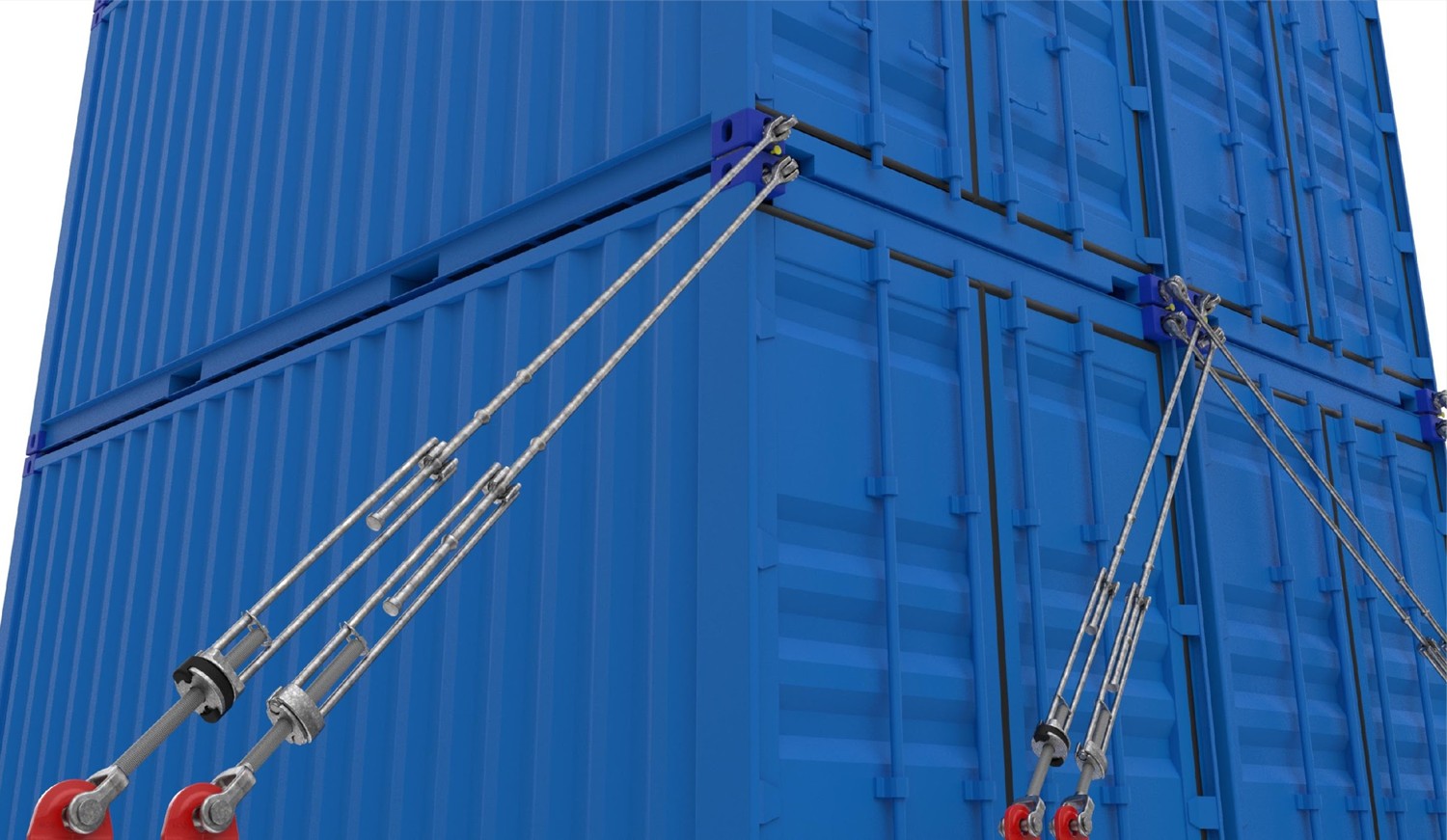
Balanced Lashing System achieves force equalisation through a simple but proven mechanical design.
- Elastic element integration allows twistlocks and lashings to engage simultaneously under load.
- Upper turnbuckle modification compensates for inherent twistlock clearance during lifting.
- Balanced Lashing ensures no single component carries excessive stress.
Retrofit-friendly design enables upgrades without hot work or structural changes. - Conventional handling and maintenance keep crew routines unchanged.
These features deliver a practical, class-approved solution that is easy to install, operate, and maintain.
 1/3
1/3
-
References
Balanced Lashing Systems are in commercial operation across 3 of the world's top 5 container lines and a wide range of other large container vessels.
At the moment, the system is confirmed for 89 orders for upcoming newbuilds and vessel conversions, capturing over 50% market share in 2025.
-
Technical Features
The Balanced Lashing System is based on a defined set of mechanical characteristics that ensure predictable load sharing and class-approved performance.
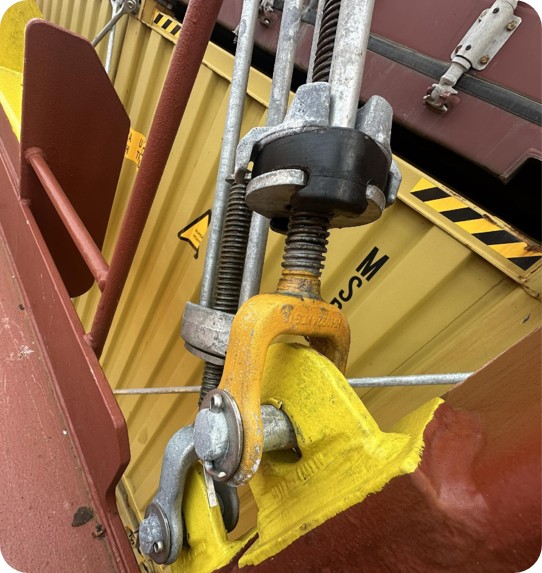
- Elastic element location positions the elastic component between the sliding nut and base plate of the upper turnbuckle.
- Controlled movement range allows approximately 12 mm of twistlock clearance to be absorbed before full load engagement.
- Simultaneous load engagement ensures upper and lower lashings and twistlocks carry tension together.
- Marine-grade elastic material provides resistance to UV exposure, ozone, and seawater.
- Protected component design keeps the elastic element enclosed within the turnbuckle body.
- Standard-function fallback allows the turnbuckle to operate as a conventional rigid unit if the elastic element is removed.
- Class-approved calculation method supports integration into loose lashing calculations.
-
Ship Types
Balanced Lashing Systems are designed for container vessels that rely on external lashing systems, usually larger than 5000TEU in size, and aim to maximise safe deck payload.
-
Solution Types
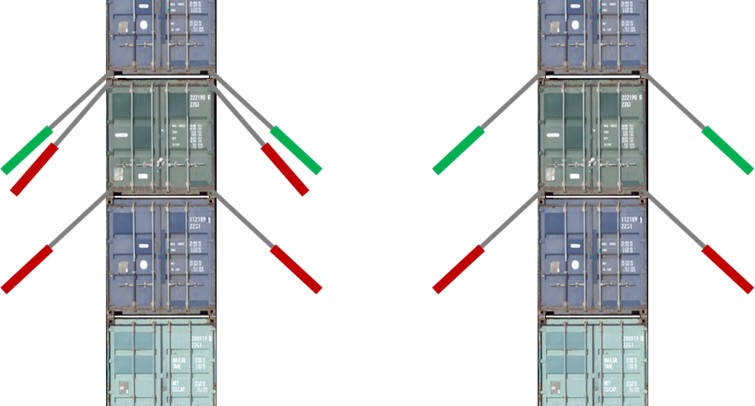
The solution is compatible with external double-cross lashing arrangements and single-cross configurations from two lashing levels. It integrates seamlessly into existing loose lashing systems.
-
Complementary Solutions
Balance Lashing System integrates seamlessly with other MacGregor lashing solutions:
- Hippo (ACV-1) Fully Automatic Twistlock
- Cargo Boost
- Lashmate Container Lashing Software
- Loose container fittings
These solutions can be delivered separately or as a complete solution.
-
Lifecycle Support
Our wide network of hubs around the world ensures you'll get the spares you need, where your vessel needs them.
Finland, Denmark, Greece
MacGregor Finland Oy
Satu Saari
satu.saari@macgregor.comEurope, Middle-East, Africa
MacGregor Germany GmbH
Jens Fuge
jens.fuge@macgregor.comAsia
MacGregor Pte. Ltd.
John Tan
john.tan@macgregor.comUnited States, Canada and Mexico (distributor)
Buffers USA Inc
sales@buffersusa.com
Tel: +1-904-696-0010Taiwan (agent)
Heng Cherng Enterprises Co.,Ltd
hengcherng@hengcherng.com
lashingsalesorder@macgregor.com
Tel: +886-2-25 65 20 63
Tel: +886-2-25 65 20 64 -
FAQ - Frequently Asked Questions
Does the Balanced Lashing System increase capital cost compared to standard lashings?
Balanced Lashing Systems are the most cost-effective way to achieve higher payload capacity and improved safety compared with alternative concepts delivering similar results.Are elastic elements or Flexilashings prone to damage?
The elastic element is manufactured from proven marine-grade material resistant to UV, ozone, and seawater. It is protected inside the turnbuckle body and is not handled like lashing bars or twistlocks.Is the service life shorter than for standard turnbuckles?
The service life is equivalent to conventional turnbuckles used in external lashing systems.Do we need to carry more spare parts onboard?
Standard amount of spare turnbuckles are sufficient. Additional spare elastic elements can be supplied, and replacement takes less than one minute without special tools.Can harsh stevedore handling cause operational issues?
Turnbuckles remain fixed in position and are not dropped or thrown during operations, reducing handling-related damage risks.What happens if the elastic element is damaged or lost?
The turnbuckle continues to function as a standard rigid turnbuckle. Operations are not delayed, and replacing the elastic element is quick and simple.Does this increase the risk of PSC deficiencies?
No. Even without the elastic element, the turnbuckle operates as a conventional unit, maintaining compliance and avoiding operational delays.Are washers or rubber elements prone to cracking or tearing under rough use?
The elastic element is developed specifically for heavy marine use. The material is comparable to MacGregor Flexipads, which have been operating reliably year after year in demanding conditions.Do replacement parts increase operating costs over time?
There is no need to replace elastic elements frequently. If required, MacGregor can supply the requested quantity of spare elastic elements without impacting normal operating costs.
Revolutionary Balanced Lashing System
On 12 March 2026, we launched our long-awaited innovation for cargo vessels: the Balanced Lashing System.
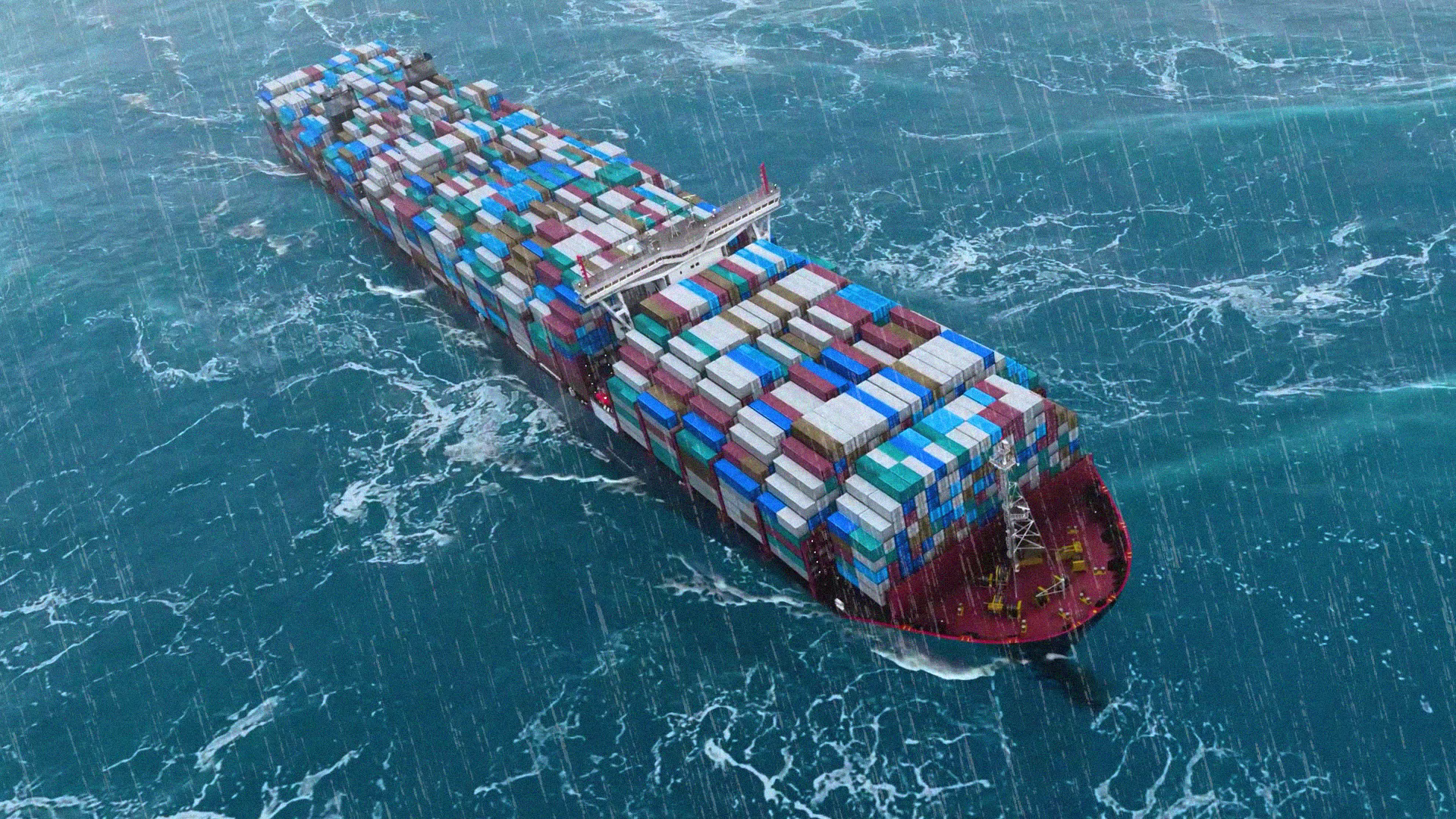

How Balanced Lashing Works: Solving Container Vessel Corner Casting Damage
Why was MacGregor’s Balanced Lashing System created? It started with a real problem: customers were reporting broken container corner castings. MacGregor’s R&D team investigated and discovered the root cause — twistlock clearance during opening was creating extra tension on the upper lashing bar in standard systems.

Balanced Lashing System for Container Vessels: More Cargo, More Earnings, Proven Safety
Discover how MacGregor’s Balanced Lashing System is transforming container shipping. In this video, we break down the key benefits: better weight distribution on deck, the ability to stack heavier containers up to one tier higher, and harmonised lashing forces between upper and lower lashing bars and twistlocks.


Balanced vs. Standard Turnbuckle: What’s the Difference for Container Vessels?
What makes the Balanced Lashing System different from a standard lashing setup? In this video, MacGregor’s Technical Manager of Loose Lashings walks us through the key difference: the upper turnbuckle contains an elastic element, while the lower turnbuckle remains a standard fixed design.

Balanced Lashing FAQ for Container Vessels: Cost, Durability, Maintenance & More
Got questions about MacGregor’s Balanced Lashing System? In this video, our experts address the most frequently asked questions from shipowners and operators — from capital expense and durability to port state control risk.