 Share
Share


Key benefits
Whether you operate handysize bulk carriers, general cargo vessels, or multipurpose tonnage, autonomous crane technology brings several benefits to your operations.
- Reduced crew workload and rest time compliance as driverless operation frees crew for other tasks and removes the conflict between intensive crane use and mandatory work/rest regulations.
- Minimised human error and improved safety through automated operations within a defined framework that prevents collisions, controls pendulation, and eliminates the need for personnel in hazardous operational areas.
- Faster discharging times are enabled by continuous, optimised crane movements that are not limited by operator fatigue or shift changes.
- Extended equipment lifetime through machine-learning grip control and automated motion patterns that reduce wear on crane components and grab equipment.
- One operator for all cranes simultaneously at Level 3 automation, where the bridge control system allows a single crew member to initiate, supervise, and manage all cranes from the vessel’s command centre.
Together, these advantages help you step into a new era of cost-efficient, productive, and sustainable cargo handling operations.
Key features
The autonomous crane system combines several advanced technologies into one integrated platform, built to perform reliably in challenging wind and sea conditions.
- LIDAR cargo scanning and unloading planning that maps the topography of material inside the hold, enabling precise grab positioning and optimised discharge sequences.
- Machine-learning Auto-Grip that adapts grab behaviour to different material characteristics, preventing overloading and optimising each grab cycle.
- Anti-collision and Auto Motion systems provide continuous motion measurement, swing dampening, and collision prevention for stable operations in dynamic sea states.
- Bridge control for remote initiation and supervision, allowing operators to start, monitor, and manually override autonomous operations from the Bridge Drivers' Desk.
- Power-balance mode that optimises energy distribution across crane operations, especially effective when combined with electric crane drive systems.
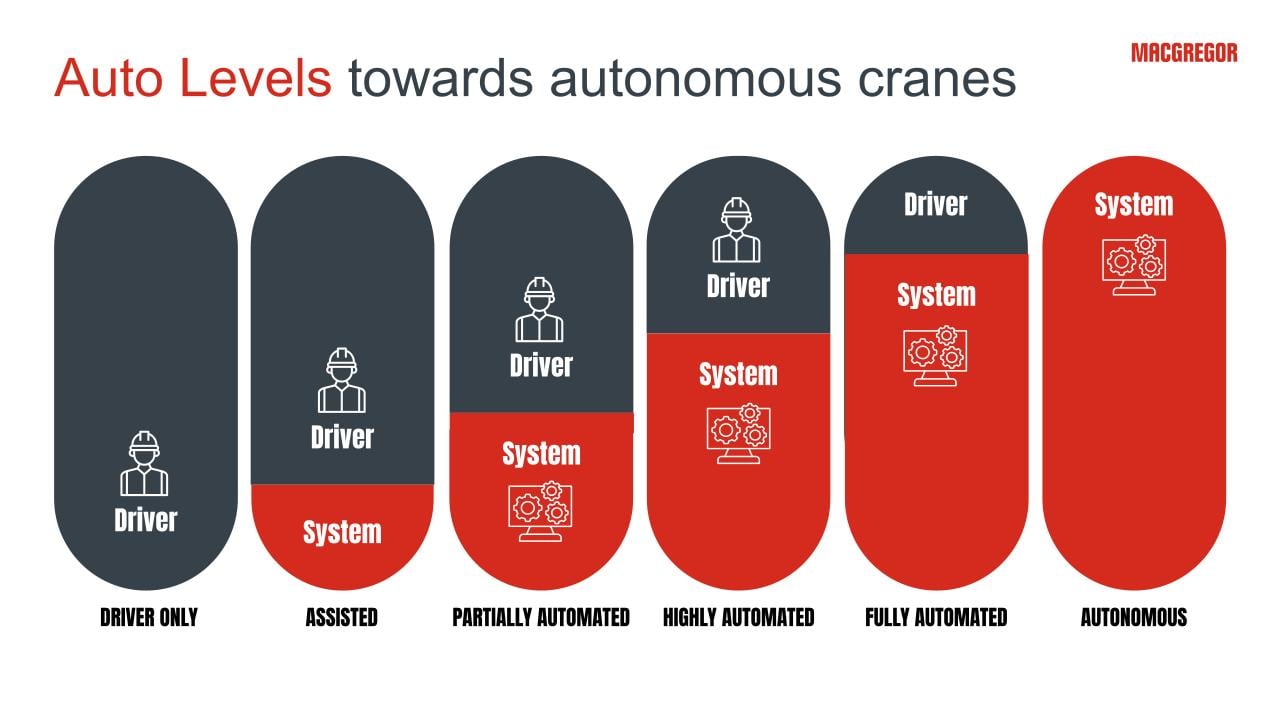
- Five levels of autonomy (L1–L5) from assisted operation at Level 1 through to highly automated at Level 3, with Levels 4 and 5 in active development on the roadmap toward full autonomy.
These features work together to deliver safe, smart, and efficient cargo handling with minimal human intervention.


 1/6
1/6
-
Technical Features
Autonomy levels
- Level 1 (Assisted): human driver retains full control; anti-pendulation and anti-collision features support safe, efficient operation.
- Level 2 (Partially automated): Auto Motion executes driving tasks in a defined area with constant monitoring; adds Auto-Grip (machine learning), and bridge monitoring of all connected cranes.
- Level 3 (Highly automated): executes tasks autonomously within defined limits, requesting operator intervention only when performance boundaries are reached; adds bridge control, cargo scan, and power-balance mode.
- Levels 4–5 (Fully automated / Autonomous): currently in development, targeting full driverless operation without human oversight.
Core technologies
- LIDAR sensors: advanced scanning for cargo topography mapping and unloading planning.
- Auto-Grip: machine-learning grab control that adapts to material properties.
- Anti-collision: continuous spatial awareness and collision prevention.
- Auto Motion: automated crane movement within defined operational zones.
- Bridge Drivers Desk: remote initiation, supervision, and manual override capability.
- Power-balance mode: energy optimisation across simultaneous crane operations.
Drive system
- Electric drive: integrated with the electric crane portfolio for maximum energy efficiency and compatibility with power-balance mode.
-
Ship Types
Autonomous crane technology is designed for the following vessel types:
- Bulk carriers (especially handysize)
- General cargo vessels
- Multipurpose vessels
-
Solution Types
Autonomous Cranes support hydraulic and fully electric vessel concepts.
-
References
ESL Shipping, the leading dry bulk cargo carrier in the Baltic Sea region, operates the Level 3 autonomous crane system on its LNG-powered vessel M/S Viikki.
-
FAQ - Frequently Asked Questions
What level of autonomy is available today?
Level 3 (highly automated) is the most advanced commercially available system. At this level, cranes execute tasks autonomously within defined limits and request operator intervention only when performance boundaries are reached. Levels 4 and 5 are in active development.Can one operator really run all cranes at the same time?
Yes. At Level 3, the Bridge Drivers Desk allows a single operator to initiate, supervise, and manage all connected cranes simultaneously from the vessel’s command centre, with manual override available at any time.Does the system work in rough weather?
Yes. The automated crane system is built to withstand challenging wind and sea conditions. Continuous motion measurement, swing dampening, and anti-collision features ensure stable operations even in dynamic sea states.Can autonomous features be added to existing cranes?
The autonomous system is designed to integrate with the electric crane portfolio. Specific retrofit options depend on your vessel configuration and existing crane setup. Contact us to discuss your requirements.

MacGregor highly automated crane system proves optimal for ESL Shipping
ESL Shipping, the leading dry bulk cargo carrier in the Baltic Sea region, operates the Level 3 autonomous crane system on its LNG-powered vessel M/S Viikki.