
 Share
Share




Forged twistlocks offer several benefits: they are durable, strong, and still light. Cast twistlocks can perform well too, but if the casting process is not optimally designed and controlled, porosity may occur. Weaker structural strength can be compensated by adding more steel, which makes cast twistlocks heavier.
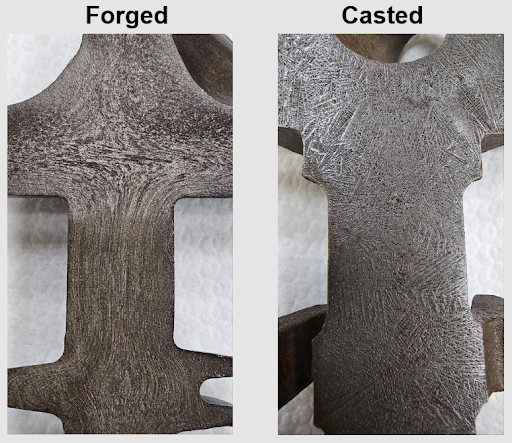
The strength advantage of forging comes from the forged steel grain pattern, which aligns with the effective forces. This can be clearly seen in one-piece fully automatic twistlocks and in the locking bolts of semiautomatic twistlocks. In photos of split semiautomatic locking bolts, the forged version (left) shows directed grains, while the cast version (right) shows a random pattern.
Forging as a manufacturing method is more demanding. It requires experience and heavy tools. Moulds wear out faster, meaning quality control must be kept at a very high level. Casting, on the other hand, is relatively easy process and the moulds maintain their dimensions for a longer time.
What about the price when comparing manufacturing methods for twistlocks?
Contrary to common belief, forged twistlocks are not more expensive. Thanks to better productivity and the need for less steel to achieve the same strength, forging can even be more competitive. But as always, both forging and casting can be executed cleverly—or not so cleverly.
At MacGregor, we manufacture Hippo fully automatic twistlocks by forging. This allows us to provide a very strong, durable and safe product at a competitive price level. In addition, forging reduces CO₂ emissions by around 40% compared to manufacturing the same product by casting!
In semiautomatic twistlocks, we offer both fully forged and partly forged designs. In hybrid models, the most critical part, such as the locking bolt, is forged, while the body, which primarily takes pressure and shear forces, can be cast.
So, how would you like your twistlocks served: forged, cast, or both on the same plate?